
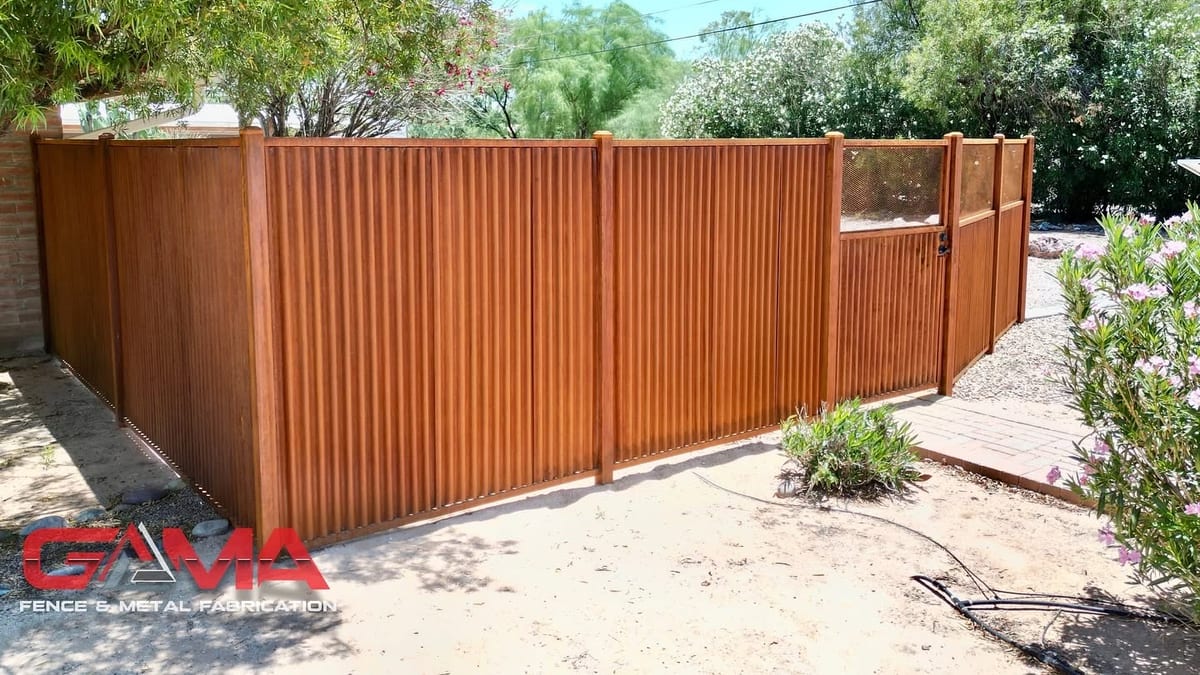
A corrugated metal fence is a privacy fence built from ribbed steel panels mounted on a post and rail frame. In Southern Arizona it typically costs $25 to $65 per linear foot installed, lasts 25 years or more on a steel frame, and handles heat, UV and monsoon rain better than wood or vinyl. The frame decides how long it lasts.
We build a lot of these across Tucson, Marana and Oro Valley, and the questions homeowners ask are almost always the same. What does it cost, will it rust, will it blow over in a monsoon, and will the HOA let me put it up? This guide answers each one with what we see on real jobs, not what a panel supplier's brochure says.
Planning a corrugated metal fence in Tucson?
Get a free same-day estimate for your property. No obligation. ROC Licensed #316344.
What is a corrugated metal fence?
A corrugated metal fence uses sheet steel pressed into a repeating wave or ridge pattern, the same profile you see on metal roofing and barns. The ridges are what make a thin sheet stiff enough to stand as a fence. Most residential panels use a 7/8 inch wave in 26 or 29 gauge steel, where the lower number is the thicker sheet.
People search for it under a handful of names: corrugated iron fence, corrugated steel fence, tin fence or metal privacy fence. They all describe the same thing. True iron is almost never used anymore, so a "corrugated iron" fence in Tucson is a corrugated steel fence with a galvanized, painted or rusted finish.
The panels are only half the fence. They get screwed or bolted to a frame of posts and horizontal rails, and that frame is either wood or steel. Keep that in mind, because it comes up again in almost every section below.
How much does a corrugated metal fence cost?
Expect roughly $25 to $65 per linear foot installed for most residential corrugated metal fence projects, with a typical 100 foot backyard run landing between $2,500 and $6,500. The national cost guide HomeGuide puts installed corrugated metal fencing at $25 to $65 or more per linear foot, or $2,000 to $6,500 for a 100 foot run. Standard 6 foot fences on flat, open lots sit toward the lower end, and the factors below push a project up the range.
Where your project lands depends on a short list of choices. Here is how the main cost drivers stack up.
| Cost factor | Lower end of the range | Higher end of the range |
|---|---|---|
| Frame material | Pressure treated wood posts and rails | Steel square tube posts and rails, welded or bolted |
| Panel finish | Bare galvanized or Galvalume | Factory painted or pre-rusted weathering steel |
| Panel gauge | 29 gauge | 26 gauge or heavier |
| Height | 5 to 6 feet | 7 to 8 feet (may need a permit) |
| Site conditions | Flat yard, soft soil, open access | Caliche, slopes, washes, tight side yards |
| Extras | Straight run, no gates | Walk gates, driveway gates, removal of an old fence |
What drives the price up in Tucson specifically?
Caliche is the big one. That cement-like soil layer shows up across much of the Tucson basin, and when an auger hits it, post holes take longer and sometimes need a breaker. It rarely doubles a price, but it is the most common reason two quotes for the same length differ.
Slopes and washes come next. Corrugated panels are rectangular, so a sloped yard gets either stepped panels or panels cut on an angle, and both add labor. Runs that cross a wash need a gap at the bottom so monsoon runoff can pass through instead of pushing against the fence.
Gates are the third. A corrugated gate needs its own rigid steel frame or it will sag within a year, which is why we fabricate them in our shop rather than hanging a panel on a pair of hinges. If you want a matching driveway gate, our automatic gate installation team can motorize the same design.
Know Your Number
SEE WHAT YOUR CORRUGATED FENCE WOULD COST
Tell us your fence length, height and gate needs. We measure the site, check for caliche and slopes, and give you a written price. Free estimates, no obligation.
How long does a corrugated metal fence last in Arizona heat?
On a steel frame, a corrugated metal fence routinely lasts 25 years or more in Southern Arizona, and the panels themselves often outlive that. On a wood frame, the fence usually lasts only as long as the wood, which in our climate can be 10 years or less.
Dry air is on the steel's side. Rust needs moisture, and Tucson spends most of the year with very little of it. The panels handle 110 degree afternoons and freezing January nights without warping, cracking or fading the way vinyl does. We covered how other materials hold up in our post on which fence material survives desert heat.
The places corrugated metal does wear out are predictable. Sprinkler overspray that hits the same panels every day, soil or gravel piled against the bottom edge, and cut edges left uncoated all rust faster than the rest of the fence. Fix those three and the panels stop being the weak point.
Which finish should you choose: galvanized, Galvalume, painted or rusted?
Choose a finish by the look you want and how close the fence sits to water. For most Tucson yards, Galvalume or a factory painted panel gives the longest life, and pre-rusted weathering steel gives the look most people have in mind when they picture a desert modern fence.
| Finish | How it looks | How it ages | Best for |
|---|---|---|---|
| Galvanized | Bright silver, dulls to gray | Zinc coating slowly wears; very durable in dry air | Budget runs, side yards, utility areas |
| Galvalume | Softer silver with a matte sheen | Aluminum-zinc coating holds up longer than plain galvanized | Long runs where lifespan matters most |
| Factory painted | Any color; tan, bronze and charcoal are popular here | Paint can chalk in strong UV over many years | HOA neighborhoods with color rules |
| Rusted or weathering steel | Warm orange to deep brown | Forms a stable surface patina; color keeps deepening | Desert modern homes, accent walls, courtyards |
Does a rusted corrugated fence keep rusting until it falls apart?
No, as long as the steel is made for it. Weathering steel, often sold as Corten, is designed to form a tight layer of surface rust that slows further corrosion, and our dry climate makes that layer form slowly and evenly. It is the finish on several of our Oro Valley projects, and you can see it in our corrugated metal fence installation gallery.
One thing the product pages leave out: rust runoff stains. For the first year or two, rain washes orange streaks off a rusted fence onto whatever sits below it. Keep new rusted panels off light concrete, pavers and stucco walls, or plan a gravel strip along the base.
Should the frame be wood or steel?
Steel. In Southern Arizona we recommend a steel tube frame for any corrugated metal fence you expect to keep more than a few years, and it is the single biggest factor in how long the fence lasts.
Wood frames fail here for two reasons. Desert subterranean termites go after wood in contact with irrigated soil, and a drip line near a fence post is an open invitation. Wood also shrinks as humidity swings between dry June and wet August, which loosens the screws holding the panels until they rattle in the wind.
A welded or bolted steel frame avoids both problems. It costs more upfront, but it lets the panels reach their full lifespan instead of being replaced along with rotten rails. Our in-house custom metal fabrication shop builds these frames to fit the yard, including stepped sections for slopes and matching gate frames.
Can a corrugated steel fence survive monsoon winds?
Yes, if it is built for them. A solid corrugated steel fence acts like a sail in a monsoon microburst, so the posts and footings take far more load than they would on an open iron or chain link fence. Built right, it stays put. Built with light posts and shallow holes, it leans after the first big storm.
A monsoon-ready solid metal fence needs four things:
- Steel posts set about 36 inches deep in concrete, rather than the 24 inches common on lighter residential work
- Closer post spacing on exposed runs, especially near the Catalinas and Rincons where gusts are stronger
- Three horizontal rails on 6 foot fences so panels cannot flex and work their fasteners loose
- A small gap at the bottom on any run that sees runoff, so water passes under instead of undermining footings
If your existing fence is already leaning after a storm, it is usually a post and footing problem, not a panel problem. Our fence repair service can reset posts without replacing every panel.
How does corrugated metal compare to wood, vinyl and block?
Corrugated metal costs about the same as vinyl upfront, less than a block wall, and more than a basic wood fence, but it outlasts both wood and vinyl by a wide margin in our climate. The table below pairs HomeGuide's corrugated range with the installed prices and lifespans from our own Southern Arizona material guide.
| Material | Installed cost per linear foot | Typical lifespan in Southern Arizona | Maintenance |
|---|---|---|---|
| Corrugated metal on steel frame | $25 to $65 | 25+ years | Rinse dust off, keep sprinklers aimed away |
| Wood privacy | $12 to $25 | 5 to 10 years | Seal every year or two, replace boards |
| Vinyl | $20 to $35 | 10 to 15 years | Low, but brittle and faded over time |
| Ornamental iron | $25 to $45 | 20 to 30 years | Touch up paint or powder coat |
| Block wall | $40 to $60 | Decades | Minimal, but needs deeper footings and often engineering |
For a side-by-side look at the three most common residential materials, see our wood vs. vinyl vs. metal fencing comparison.
Does a corrugated metal privacy fence get too hot?
It gets hot to the touch in summer, like any metal in full sun, but it does not get hot enough to damage itself. The practical concerns are plants, pets and kids, not the fence.
Dark painted and rusted panels absorb the most heat and radiate it back toward whatever grows along them. Heat-sensitive shrubs planted tight against a west-facing corrugated metal privacy fence can scorch. Give plantings a couple of feet of space, or pick a lighter tan or Galvalume panel on the west and south sides of the yard.
For dogs that like to lean on the fence or dig along it, a steel frame with the bottom rail close to grade keeps them in without exposing sharp panel edges. Cut panel edges along the top and bottom should be capped or hemmed for the same reason.
Do you need a permit or HOA approval?
Often, yes, and the answer depends on the height, where the fence sits on the lot and which jurisdiction you are in. The City of Tucson, Pima County, Marana and Oro Valley each set their own rules, and taller fences and anything near the street get the most scrutiny. Our breakdown of fence permits in Tucson covers the details.
HOAs are the bigger hurdle for corrugated metal. Some communities ban it outright, some allow painted panels in approved colors only, and a few welcome the rusted look. Get written approval before anything is ordered. Our guide to HOA fence rules in Tucson explains what boards usually ask for.
Should you install a corrugated metal fence yourself?
You can, and panel kits make it look easy. The panels are rarely the hard part. The work that trips up DIY installs is the part you do not see: digging through caliche, setting posts plumb and deep enough for monsoon loads, and building gates that do not sag.
Corrugated metal fence panels also have sharp edges and need to be cut with the right blade to avoid burning off the coating, which is where rust starts. If you do it yourself, seal every cut edge and set posts deeper than the kit instructions suggest.
If you would rather have it done once and done right, our crew handles the full job with no subcontracting, from the property assessment to the final walkthrough.
Frequently Asked Questions
Is a corrugated metal fence cheaper than wood?
Not upfront. A basic wood privacy fence usually costs less to install. Over 20 years, corrugated metal on a steel frame usually costs less, because a wood fence in Southern Arizona often needs replacing once or twice in that time.
Can you paint corrugated fence panels?
You can, but factory painted panels hold up far better than paint applied in the field, which tends to peel in strong UV. If you want a color, order it from the factory.
Should the panels run horizontal or vertical?
Both work. Vertical ridges shed water and dust more cleanly and suit most yards. Horizontal ridges give a more modern look and need a frame with more vertical support so the panels do not bow.
Will sprinklers make the fence rust?
Daily overspray on the same panels is the most common cause of early rust we see. Adjust spray heads so they point away from the fence, or switch those zones to drip.
Is corrugated metal fencing fire resistant?
Steel panels do not burn, which makes a corrugated steel fence a sensible choice for homes near the desert or the foothills. A wood frame will still burn, which is one more reason to use steel posts and rails.
Can you add a gate to a corrugated metal fence?
Yes. The gate needs its own welded steel frame to stay square. We build walk gates and driveway gates to match the fence, and driveway gates can be automated.
Get a corrugated metal fence built for Southern Arizona
A corrugated metal fence is one of the best-value privacy fences you can put up in the desert, as long as the frame, footings and finish are chosen for our heat, soil and storms. Gama Fence has built fences across Tucson and Southern Arizona for more than 20 years, with our own crew on every job and a fabrication shop for frames and gates. Request a free corrugated metal fence estimate or call (520) 808-9151 for a same-day estimate. We are ROC licensed (#316344), fully insured, family owned, and we never subcontract the install.
Ready to Get Started?
GET A FREE ESTIMATE FROM GAMA FENCE
Same-day estimates available. Serving Tucson and all of Southern Arizona. ROC Licensed #316344.